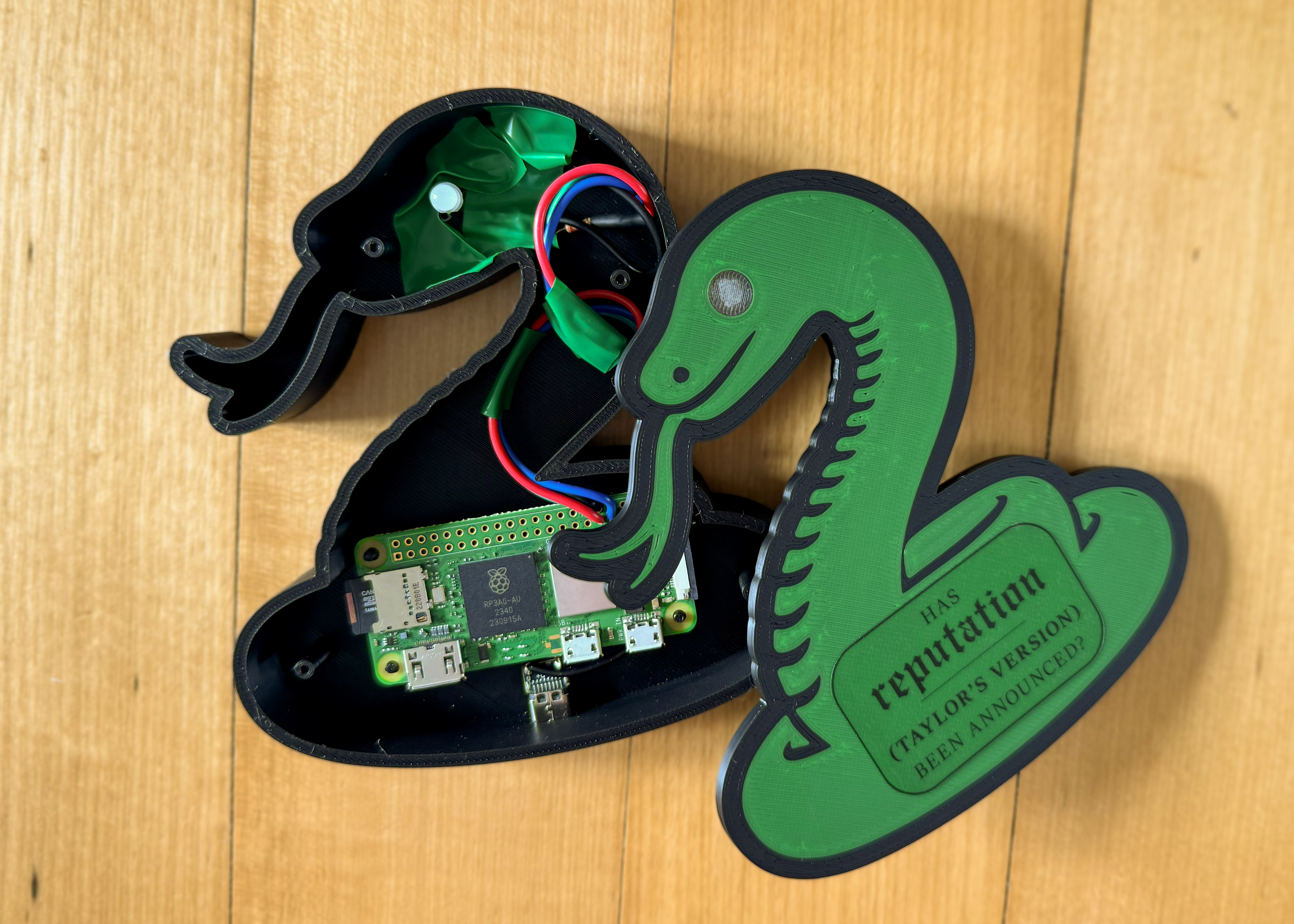
Swifties around the world were eagerly awaiting the news: when will Reputation (Taylor's Version) be announced? To make sure I didn't miss the news, I set up the Reputation Alarm.
The Reputation Alarm monitors Taylor Swift's Instagram feed for the word 'reputation'. If it appears in a post, it would start flashing the LED.
The whole system was neatly packed together in a custom 3D-printed case, designed in SolidWorks. The case snaps together with no non-printed parts required.
- Raspberry Pi Zero W: Physical hardware for the project
- RGB LED: For flashing patterns when the news was announced
- Python: Main programming language for the project
- Custom RSS.app json feed: For retrieving Taylor Swift's Instagram posts
- SolidWorks: CAD software to design the physical case, for printing on a Bambu Lab P1S
I wanted the device to be active at all times, monitoring Taylor Swift's Instagram for any mention of "reputation". I reasoned the chance of a false alert was low; a quick scan of previous posts showed it wasn't typically used outside of references to the album, and those came few and far between. I used a Raspberry Pi Zero W I already had, soldering a replacement connector for the power so I could use one of my many USB-C cables rather than tracking down a micro USB cable.
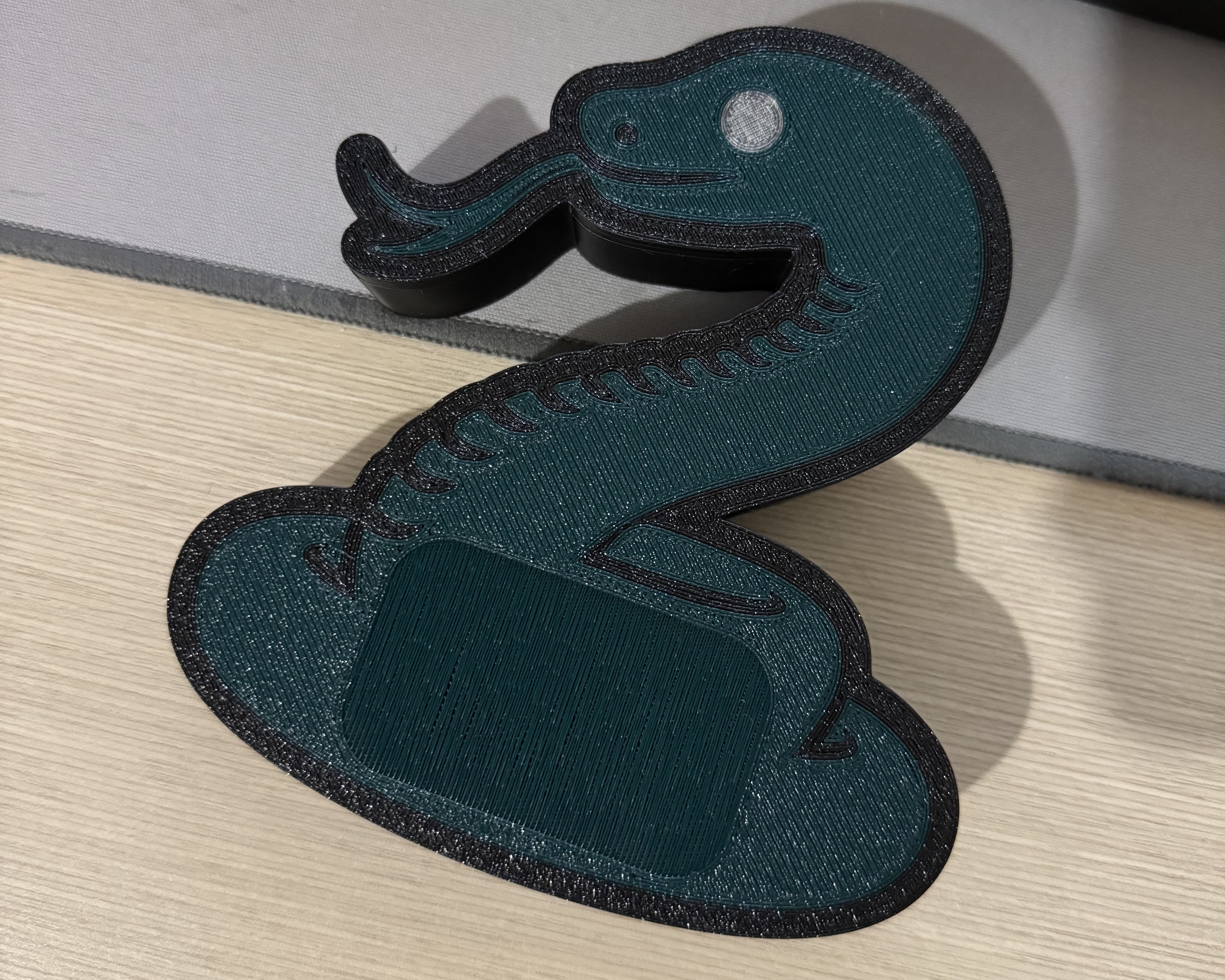
The case was designed in SolidWorks and only took two iterations. It's a simple two-part model, switching between green and black on the face plate with minimal filament waste. The initial print had a space left for a label, however it looked better when it was left as a single solid piece. The eye was tested in white and translucent PLA. The white PLA ended up blocking more of the colour than I was satisfied with. Finally, the completed version used a brighter green and a smooth build plate for better texture.
Onto the code! I leveraged pigpio to allow direct access to the Raspberry Pi's GPIO pins for controlling the LED. The actual LED code takes the red, green and blue values of the desired colours and transitions between them with a simple loop. By adding more colours, or changing the durations, a variety of patterns could be made.
I found RSS.app to convert Taylor Swift's Instagram feed into a readable json form. The Pi code then polls the feed every five minutes, to try balance up-to-date information with too-regular requests. If the word "reputation" is found in a post caption, it triggers the alarm.
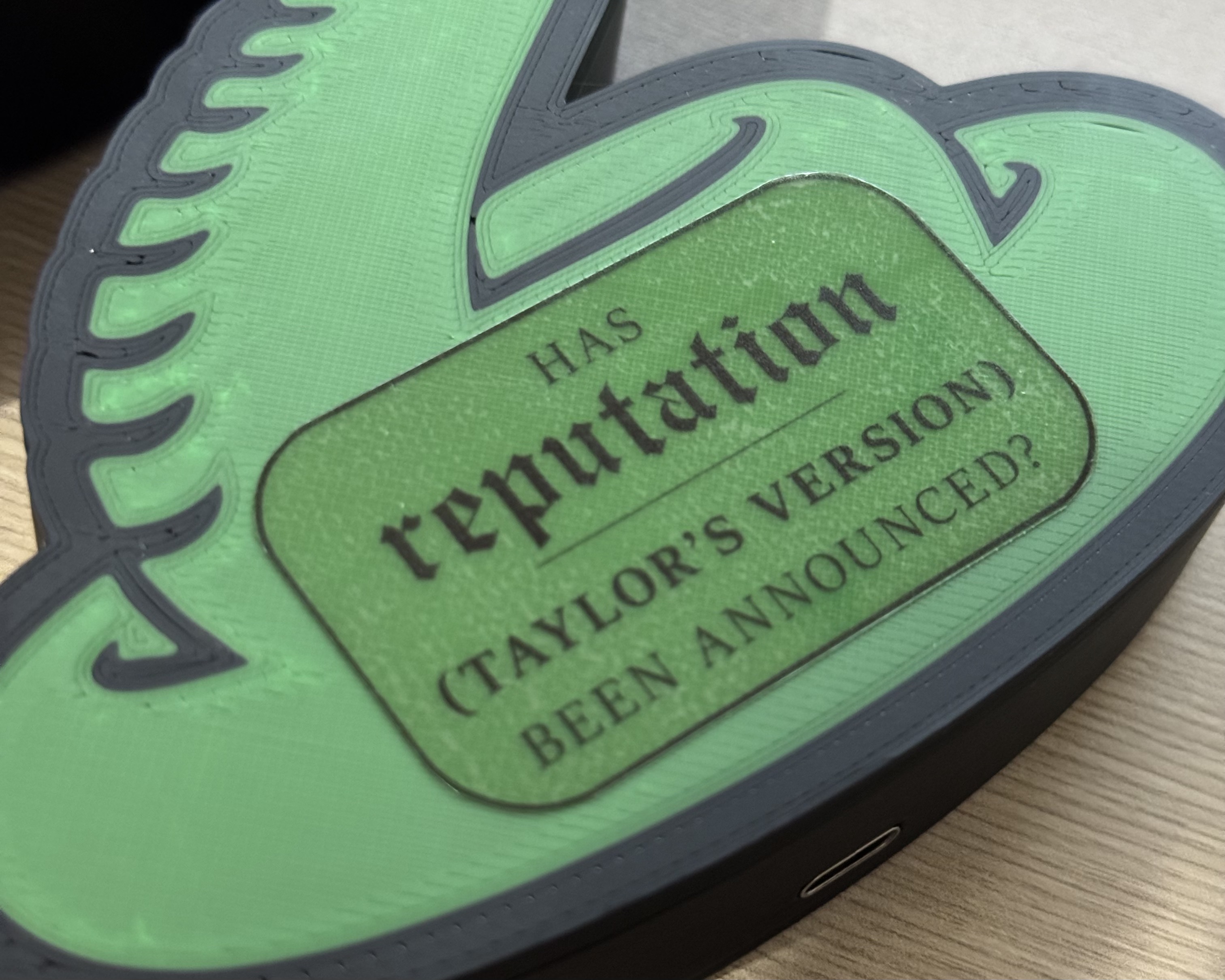
Finally, the unit was assembled. Each piece was taped into place and some mounting stickers were attached to the back, to go on the side of my bookshelf waiting for the news to be announced.
... until May 30, 2025, when Taylor Swift announced she'd managed to repurchase her masters and Reputation (Taylor's Version) wouldn't be coming after all. At least it was a good project!
Reputation (Taylor's Version) may never be coming, but the code can easily be modified to track other social media feeds for specific trigger words. This could then be packaged as a single, distributable software. Care would need to be taken to prevent any privacy breaches, if it were distributed more widely.
The LED was rather roughly secured. A better-designed case would keep the LED and wiring secured without the need for electrical tape.
Finally, at the moment, the code rechecks all of the posts in the RSS feed each time. It could be reworked to keep the latest post and only update and run the full code if a different post is detected.